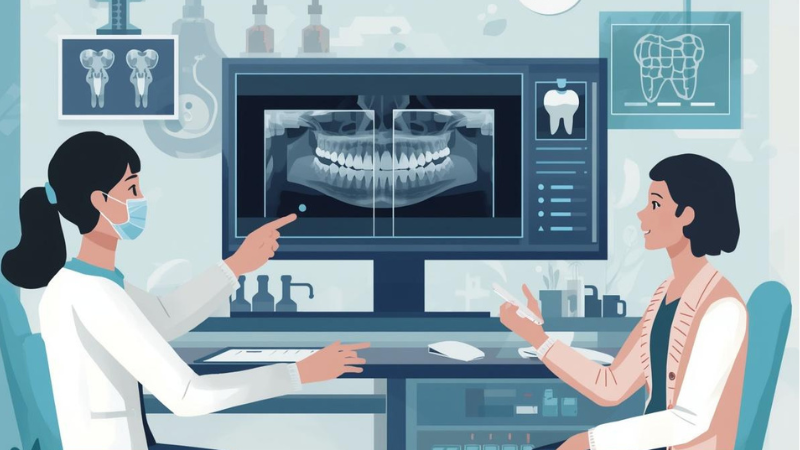

Artificial Intelligence is everywhere in dentistry right now.
AI note takers.
AI diagnostics.
AI phone systems.
AI treatment planning tools.
AI dashboards promising growth, efficiency, and profitability.
Scroll LinkedIn for five minutes and you would think artificial intelligence is the missing piece standing between your practice and exponential success.
But here is the uncomfortable truth that many leaders in dentistry are quietly acknowledging. AI is not killing dentistry. And it is not saving it either. What AI is doing is something far more confronting. It is exposing a real skills problem in dentistry.
The Myth That Technology Alone Drives Growth
There is a growing belief that adding more technology to a dental practice automatically leads to better outcomes. Better production. Better revenue. Better patient experiences.
In reality, no practice management system, diagnostic tool, phone platform, or AI assistant can fix production or revenue challenges on its own. Dentistry does not work that way.
A restaurant does not increase revenue just because it installs a better ordering system if the chef cannot keep up with demand or execute dishes consistently. Dentistry is no different.
If the clinician cannot consistently perform procedures efficiently, make sound decisions, and confidently communicate treatment, no amount of software will create sustainable growth.
Revenue is still generated chairside. By work completed in the operatory. By the dentist.
AI Does Not Replace Clinical Capability
AI has an important role in modern dentistry. That part is not up for debate. Automation can reduce admin load. AI can assist with diagnostics. Technology can streamline workflows and support decision making. But AI does not replace clinical capability. It amplifies what already exists.
If fundamentals are strong, AI can enhance efficiency and clarity. If fundamentals are weak, AI exposes those weaknesses quickly. This is why some practices feel friction instead of leverage when they add more tools.
AI highlights:
- Slow or inconsistent hand skills
- Unclear treatment planning logic
- Hesitation or lack of confidence in case presentation
- Inefficient workflows at the chair
- Overreliance on single tooth dentistry
When these gaps exist, adding technology does not solve the problem. It magnifies it.
The Real Constraint to Growth Is Still the Dentist
This is not an attack on clinicians. It is a reality of how dentistry functions as a profession. Your true constraint to growth is still the dentist. Not because dentists are the problem. But because dentistry is a hands on, decision driven, human profession.
If a clinician is:
- Struggling with efficient execution
- Uncertain in decision making
- Inconsistent in treatment planning
- Uncomfortable with patient communication
Then production will plateau, regardless of how advanced the software stack becomes.
AI can suggest.
AI can prompt.
AI can organise.
But it cannot:
- Prep a tooth
- Manage tissue predictably
- Adapt clinically in real time
- Build trust chairside
- Confidently guide a patient through complex treatment
Those responsibilities still sit squarely with the clinician.
The Risk of Flooding Practices With Technology
One of the biggest issues we are seeing globally is the unstructured layering of AI tools into practices.
Multiple platforms.
Overlapping features.
Competing workflows.
All introduced without a clear plan for how they integrate operationally, clinically, or culturally. Instead of leverage, this creates friction.
Dentists are asked to adapt to new tools without clarity on how those tools support their actual day to day clinical work. Teams become overwhelmed. Systems clash. Efficiency drops instead of improving.
Technology without strategy does not create growth. It creates noise. And when foundational clinical skills are lacking, AI only makes those gaps more visible.
Dentistry Has a Skills Problem Bigger Than AI
The conversation around AI in dentistry often skips over a deeper issue. Dentistry has a skills problem right now. Many clinicians have not been given the structure, mentorship, or repetition needed to build:
- Predictable procedural workflows
- Strong clinical decision making
- Confident treatment conversations
- Efficient chairside execution
Instead, the industry is attempting to surround clinicians with smarter tools in the hope that technology will compensate for gaps in training or experience. It will not. If the fundamentals are not strong, there will be no meaningful uplift in productivity or quality, no matter how advanced the software becomes.
Where Real Productivity Gains Actually Come From
The future of dentistry is not AI versus clinicians. It is high performing clinicians, supported by AI, operating inside repeatable systems. That is where real productivity gains happen.
When procedural skills are refined, AI can help reduce friction. When decision quality is strong, AI can enhance consistency. When workflows are clear, technology becomes an amplifier instead of a distraction.
The order matters.
Procedural skills first.
Decision quality next.
Technology as the amplifier.
Not the other way around.
Why Skills Based Education Still Matters
The most important investment a practice can make is not another platform subscription. It is developing the skills, efficiency, and confidence of the clinicians delivering care.
That means:
- Mastering predictable procedures
- Improving treatment planning logic
- Building confidence in complex cases
- Communicating treatment clearly and ethically
- Reducing chairside stress through efficiency
When clinicians operate at a high level, technology supports them naturally. When they do not, technology becomes a crutch that eventually fails.
The Role of AI in the Future of Dentistry
AI is not going away. Nor should it.
The innovation happening in dentistry right now is exciting. Automation, data insights, and intelligent tools will absolutely shape the future of practice management and patient care. But for the foreseeable future, dentistry remains a profession where outcomes are driven by the clinician in the chair.
AI does not generate revenue.
Dentists do.
AI does not deliver care.
Dentists do.
AI does not build trust with patients.
Dentists do.
Building Sustainable Growth the Right Way
Sustainable growth in dentistry comes from synergy.
Clinical skill.
Decision quality.
Clear systems.
Supportive technology.
When those elements work together, practices thrive.
When technology is layered on top of weak fundamentals, the cracks become impossible to ignore. That is why the most forward thinking practices are not asking how much AI they can add. They are asking how to develop clinicians who can perform at a high level consistently and confidently, with technology supporting them, not replacing them.
Artificial Intelligence is not killing dentistry. It is revealing where dentistry needs to evolve. The future belongs to clinicians who invest in their skills, refine their systems, and use technology as an amplifier, not a shortcut. That is where real growth starts. And that is where it will continue.