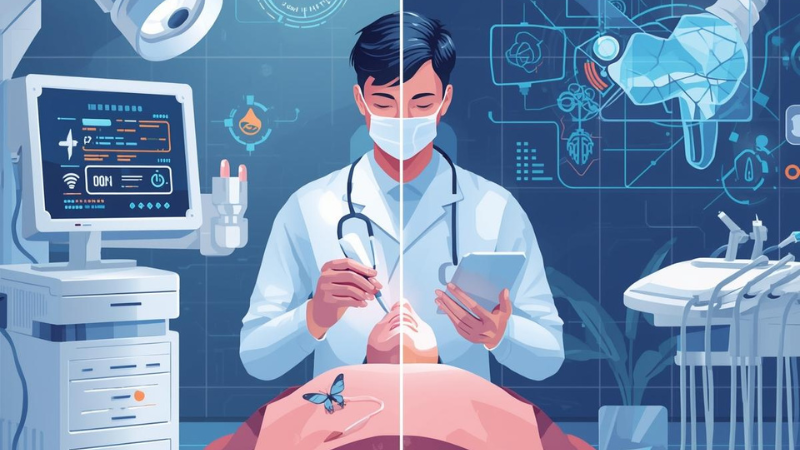
Artificial intelligence is rapidly reshaping many aspects of healthcare, and dentistry is no exception. While most dentists associate artificial intelligence with administrative automation or practice management tools, its most transformative potential may lie in diagnostic dentistry.
AI driven diagnostic systems are now capable of analysing dental radiographs, identifying pathology, assisting with treatment planning, and improving clinical decision making. As these technologies mature, they are beginning to influence how dentists diagnose disease, communicate with patients, and deliver treatment.
Understanding how artificial intelligence integrates into diagnostic dentistry is becoming increasingly important for clinicians who want to stay current, improve diagnostic accuracy, and deliver better patient outcomes.
What Is Artificial Intelligence in Dentistry?
Artificial intelligence in dentistry refers to machine learning algorithms that analyse clinical data and identify patterns that assist with diagnosis, risk assessment, and treatment planning.
Most current AI applications in dentistry rely on deep learning, a subset of machine learning that trains algorithms using large datasets. These systems learn to recognise patterns within radiographs, intraoral scans, and clinical images.
Once trained, AI tools can assist dentists by detecting conditions such as:
- Dental caries
- Periodontal bone loss
- Periapical pathology
- Calculus deposits
- Restorative margins
- Impacted teeth
- Early signs of disease that may be difficult to detect visually
Rather than replacing clinical judgment, these systems function as clinical decision support tools, providing additional insights to assist dentists in making more informed diagnoses.
AI Powered Radiographic Analysis
One of the most widely adopted applications of artificial intelligence in dentistry is radiographic interpretation.
Dental radiographs contain a large amount of diagnostic information, but interpreting them accurately requires experience and careful attention. Subtle signs of pathology can sometimes be missed, particularly in busy clinical environments.
AI powered radiographic software can analyse images in seconds and highlight areas of concern.
Common capabilities include:
- Detecting proximal caries
- Identifying periapical radiolucencies
- Measuring periodontal bone levels
- Flagging potential pathology
- Identifying defective restorations
Studies have shown that AI assisted radiograph analysis can significantly improve diagnostic consistency among clinicians.
A 2020 systematic review published in Dentomaxillofacial Radiology found that deep learning systems demonstrated high accuracy in detecting dental caries on radiographs, often performing at levels comparable to experienced dentists (Schwendicke et al., 2020).
This technology acts as a second set of eyes, helping clinicians identify pathology that may otherwise go unnoticed.
Improving Diagnostic Consistency
One of the challenges in dentistry is variability in diagnosis. Two clinicians reviewing the same radiograph may identify different findings depending on their training, experience, and clinical focus.
Artificial intelligence has the potential to reduce this variability.
By applying consistent criteria to image analysis, AI tools can standardise aspects of diagnosis. This does not eliminate the role of the dentist but provides a reference point that supports clinical decision making.
For example, AI software can automatically measure periodontal bone levels and flag areas that fall outside normal parameters. This allows dentists to detect early periodontal disease more consistently and track disease progression over time.
For clinicians working in group practices or multi location clinics, AI supported diagnostics can also improve communication between practitioners by providing objective reference points.
Enhancing Patient Communication and Case Acceptance
Beyond improving diagnostic accuracy, AI tools are also changing how dentists communicate findings with patients.
One of the biggest barriers to case acceptance in dentistry is patient understanding. Radiographs and clinical photographs can be difficult for patients to interpret, making it challenging to explain the need for treatment.
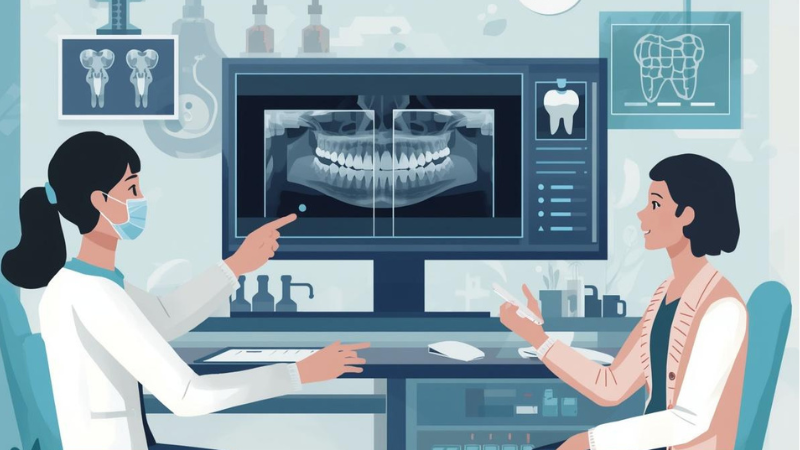
AI diagnostic systems often provide visual overlays that highlight areas of concern directly on the radiograph. These visual indicators help patients clearly see where problems exist.
When patients can visually understand:
- where decay is located
- how bone loss is progressing
- why a restoration has failed
they are more likely to understand the need for treatment.
Improved patient understanding often leads to greater trust and increased treatment acceptance.
In this way, artificial intelligence is not only a diagnostic tool but also a powerful communication aid.
Early Detection and Preventive Dentistry
One of the most promising impacts of artificial intelligence in dentistry is the potential for earlier detection of disease.
Early diagnosis is critical for preventive and minimally invasive dentistry. The earlier pathology is identified, the more conservative treatment can be.
AI systems trained on large datasets can detect extremely subtle patterns that may be difficult for the human eye to identify. These early indicators may allow clinicians to identify disease before it progresses into more advanced pathology.
Examples include:
- early enamel caries
- minor periodontal bone changes
- small periapical lesions
- early restorative defects
This supports a shift toward preventive and minimally invasive treatment strategies, which aligns with modern approaches to dentistry.
Limitations and Considerations
Despite its potential, artificial intelligence in dentistry is not without limitations.
AI systems depend heavily on the quality and diversity of the datasets used to train them. If training data is limited or biased, the system may not perform consistently across all clinical scenarios.
Other limitations include:
- false positives that may over detect pathology
- dependence on image quality
- integration challenges with existing dental software
- the need for clinician oversight
Artificial intelligence should be viewed as an assistive tool rather than a replacement for clinical expertise.
Dentists must continue to apply their clinical judgment when interpreting AI generated findings.
Regulatory frameworks are also evolving as AI becomes more integrated into healthcare. Ensuring patient privacy, data security, and ethical use of AI technologies will remain important considerations.
The Future of AI in Diagnostic Dentistry
Artificial intelligence is still in the early stages of adoption within dentistry, but its capabilities are evolving rapidly.
Future developments may include:
- integration with intraoral scanners and digital workflows
- predictive risk modelling for caries and periodontal disease
- AI assisted treatment planning
- automated monitoring of disease progression
- personalised preventive care recommendations
As digital dentistry continues to expand, artificial intelligence will likely become a standard component of diagnostic workflows.
Clinicians who understand how to leverage these technologies effectively will be better positioned to deliver efficient, data driven care.
Why Dentists Must Stay Educated on Emerging Technologies
The rapid evolution of dental technology highlights the importance of continuing education.
Artificial intelligence, digital workflows, and advanced treatment planning tools are already influencing how dentistry is practiced. Dentists who remain engaged with ongoing education are better equipped to integrate these innovations into their clinical workflows.
Beyond technology itself, modern dental education increasingly focuses on clinical decision making, treatment planning, and interdisciplinary thinking, all of which become more important as digital tools expand diagnostic capabilities.
Learning how to interpret diagnostic data, evaluate technology critically, and apply it within real clinical cases is essential for maintaining high standards of care.
Conclusion
Artificial intelligence is beginning to play a significant role in diagnostic dentistry. By assisting with radiographic analysis, improving diagnostic consistency, supporting patient communication, and enabling earlier detection of disease, AI has the potential to enhance clinical decision making and improve patient outcomes.
However, artificial intelligence should be viewed as a supportive technology rather than a replacement for clinical expertise. The role of the dentist remains central in interpreting diagnostic findings, planning treatment, and delivering patient care.
As dentistry continues to evolve, clinicians who remain engaged with emerging technologies and ongoing education will be best positioned to integrate artificial intelligence effectively into their practices.