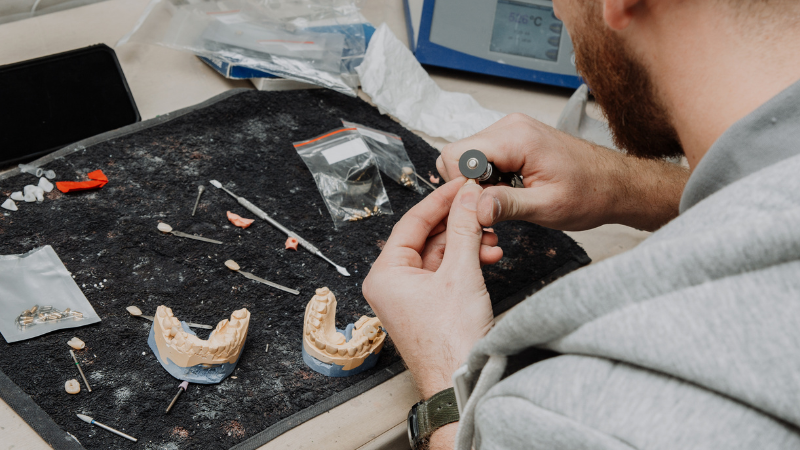

There is a strange gap in dentistry that does not get talked about enough. A dentist can understand crown preparations in theory, place crowns in practice, and still feel inconsistent every time a bigger indirect case appears in the diary. That gap is not always a knowledge problem. It is often a confidence problem. More specifically, it is a repetition problem.
Because crown preparation confidence is not built by watching one perfect demonstration. It is not built by reading about margin design once. It is not built by hoping that the next case will feel easier than the last. It is built by doing the movements, receiving feedback, correcting the errors and repeating the workflow until it becomes more controlled, more efficient and more predictable.
This is where many dentists get stuck. They know what they are trying to achieve, but they have not had enough structured repetition to make the process feel reliable.
Knowing the theory is not the same as owning the skill
Most dentists understand the basic goals of a crown preparation.
Adequate reduction. Clear margins. Appropriate taper. Smooth surfaces. Sufficient clearance. Protection of the tooth. Respect for the tissue. A restoration that fits, functions and lasts. The problem is not always understanding the destination. The problem is getting there consistently under real clinical pressure.
A crown prep in a textbook is clean. A crown prep in practice is not always so polite. The patient may be anxious. The access may be poor. The tissue may bleed. The existing restoration may be deeper than expected. The tooth may have cracks, structural compromise or subgingival margins. The schedule may be tight. The assistant may be new. The next patient may already be waiting.
Suddenly, the theory needs to become a repeatable clinical process. That is where hand skills, judgement, sequencing and mental clarity matter.
Confidence comes from reducing uncertainty
Dentists often think confidence means feeling fearless. It does not.
Clinical confidence means you have a system for what to do next. It means you understand the decision points. It means you can recognise when a case is becoming more complex and adjust your workflow instead of panicking. In crown preparation, uncertainty can creep in at every stage.
How much reduction is enough?
Where should the margin sit?
Should this be a conventional or vertical preparation?
How should the provisional be managed?
Will the scan capture the margin?
Is the occlusion going to overload the restoration?
Should this tooth be restored at all?
When there is no clear system, each question adds mental load. That mental load slows you down and increases stress. A repeatable workflow reduces that uncertainty. It does not make every case simple, but it gives you a clearer way to think, plan and execute.
Repetition builds muscle memory
Crown preparation is not just a thinking exercise. It is also a physical skill.
Bur control matters. Hand position matters. Path of insertion matters. The way you move around the tooth matters. Your ability to maintain consistency through the preparation matters. These skills improve with deliberate repetition.
Not casual repetition. Not “I have done a lot of crowns over the years” repetition. Deliberate repetition means practising with a purpose, reviewing the result, identifying what needs to change and doing it again. This is why simulation training can be so valuable. It gives dentists the chance to focus on the skill itself without the full complexity of a live patient appointment. It allows you to repeat the movement, develop muscle memory and receive feedback on the details that may be difficult to assess on your own.
Speed also improves through repetition, but speed is not the first goal. Control is the first goal. Once control improves, efficiency follows.
Feedback changes everything
One of the hardest parts of improving crown preparations in daily practice is that dentists often work alone. You prepare the tooth. You send the case to the lab. You cement the crown. You move on.
Unless something goes wrong, you may not get detailed feedback on the quality of the preparation, the margin design, the reduction, the smoothness, the sequence or the scan. Even when the crown fits, there may still be areas where the workflow could be improved. This makes growth slower than it needs to be.
Feedback helps shorten that learning loop. It gives you another set of experienced eyes on your work. It helps you see patterns you may not notice yourself. Maybe your margins are consistently unclear in one area. Maybe your taper changes depending on access. Maybe your reduction is uneven. Maybe your temporaries are taking longer because the prep sequence is not supporting the provisional.
Good feedback is not about criticism. It is about giving you the information you need to improve faster.
The stress of crown preps is often the stress of decision-making
A crown preparation can feel stressful because there is so much happening at once. You are managing the tooth, the patient, the tissue, the assistant, the timing, the occlusion, the material choice, the provisional, the scan or impression and the final outcome. It is a lot. When the workflow is not well rehearsed, your brain has to make too many decisions in the moment. That creates fatigue. This is why structure matters. A clear workflow frees up mental space. Instead of constantly asking, “What now?”, you can move through the appointment with more clarity.
This does not mean switching off your judgement. It means your judgement is supported by a system. The more repeatable the system becomes, the more energy you have available for the parts of dentistry that truly require clinical thinking.
Why crown confidence matters for bigger cases
Many dentists want to move into more private indirect restorative work, larger cases or quadrant dentistry. But bigger cases expose inconsistencies.
If a single crown workflow feels unpredictable, preparing a quadrant of crowns can feel overwhelming. If temporaries are inconsistent on one tooth, they become more stressful across multiple teeth. If occlusion is an afterthought in simple cases, it becomes a much bigger risk when more restorations are involved. This is why crown preparation confidence is foundational.
It is not just about doing better single crowns. It is about developing the clinical systems that allow you to take on more complex restorative work with less chaos. A dentist who can prepare efficiently, manage margins clearly, control tissue, understand occlusion, create functional provisionals and capture accurate scans or impressions is better positioned to grow into larger indirect cases.
Patient communication is part of the confidence gap too
Crown preparation confidence is not only technical. Patients need to understand what is happening, why treatment is recommended and what to expect. If the patient is confused, anxious or uncomfortable, the appointment becomes harder for everyone. Clear communication can improve case acceptance, patient trust and chairside flow. It can also reduce stress during the procedure because the patient is more prepared and more cooperative.
This is especially important when moving from volume-based dentistry into more comprehensive private restorative work. Patients may have more questions, higher expectations and greater emotional investment in the outcome. A confident workflow includes patient-centred communication, not just clinical execution.
The goal is not perfection. It is predictability.
Dentists can be hard on themselves.
It is easy to look at crown preparations online and feel like everyone else is producing flawless margins, perfect temporaries and effortless scans every time.
But real dentistry is messier than that.
The goal is not to become a robot. The goal is to become more predictable. To know what you are aiming for. To have a system. To recognise problems earlier. To recover when things do not go perfectly. To develop enough repetition that the workflow feels less mentally exhausting.
Predictability is what allows confidence to grow.
How to close the crown prep confidence gap
Closing the confidence gap requires more than another lecture on preparation design. It requires a combination of theory, clinical judgement, simulation, repetition, workflow training and feedback.
You need to understand why you are choosing a preparation design. You need to understand how occlusal forces influence restorative success. You need to know how to manage tissue and capture accurate records. You need to be able to create provisionals that support the case. You need to practise the hand skills enough that they become more consistent.
Most importantly, you need a framework that connects all of those pieces together. That is when crown preparations start to feel less like isolated procedures and more like a repeatable restorative workflow.
Ready to build more confidence in crown preparations?
RipeGlobal’s Crown Preparations Master Series is designed for general dentists and associates who can already place crowns, but want a more systematic, repeatable approach.
The course combines clinical learning with live online simulation training, helping you improve bur control, hand skills, preparation quality, speed and consistency. It also explores preparation design, patient comfort, occlusion essentials, temporisation, impressions, scanning and quadrant crown workflows.
If crown preparations still feel inconsistent, stressful or overly dependent on how the day is going, this course is built to help you close that confidence gap.
Explore the Crown Preparations Master Series and start building a crown workflow you can actually rely on.