A provisional crown is easy to treat like the awkward middle step of indirect dentistry.
The tooth has been prepared. The scan or impression is complete. The laboratory has the case. Now you just need something that looks acceptable, stays attached, and gets the patient through to the final appointment.
That approach may work occasionally, but it misses how much useful information a provisional can provide.
A well-made provisional protects the tooth, maintains contacts and occlusion, supports the surrounding tissue, and gives the patient an early sense of the proposed result. In anterior cases, it can also help the dentist, patient, and technician evaluate tooth shape, length, contour, and smile design before the definitive restoration is made.
The provisional is not simply covering the preparation while everyone waits.
It is part of the treatment.
What is a provisional crown supposed to do?
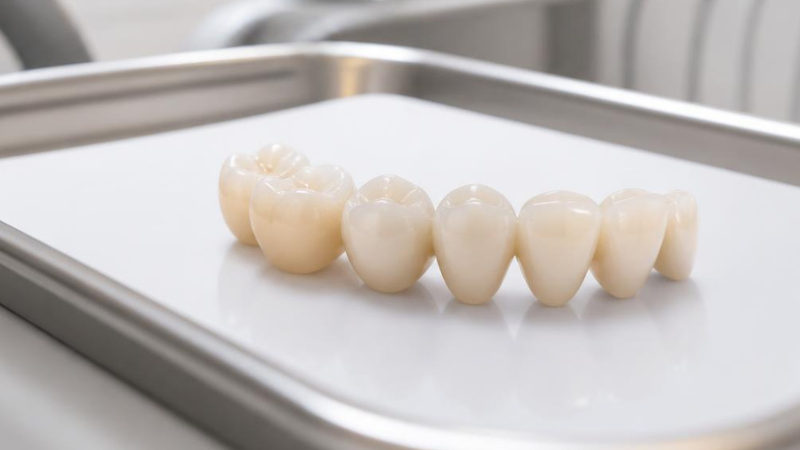
A provisional crown, sometimes called a temporary crown, is placed after tooth preparation and worn until the definitive restoration is ready.
Its role extends well beyond appearance.
A provisional restoration may need to:
- Protect exposed dentin and the pulp
- Reduce sensitivity
- Maintain the position of the prepared and adjacent teeth
- Preserve proximal contacts
- Maintain occlusal relationships
- Support gingival health
- Restore function
- Provide acceptable esthetics
- Help assess tooth shape and contour
- Test elements of the treatment plan
- Communicate useful information to the laboratory
Reviews of provisional restorations consistently describe them as biologic, biomechanical, diagnostic, and esthetic components of fixed prosthodontic treatment, rather than simple placeholders.
The exact priorities will vary between cases. A posterior provisional may need to withstand significant occlusal forces and maintain a stable contact. An anterior provisional may also need to reflect a carefully planned esthetic design and help the patient understand what their new smile could look like.
The provisional protects the prepared tooth
Preparing a tooth removes enamel and may expose dentin.
Until the definitive restoration is placed, the prepared surface needs protection from temperature changes, bacterial contamination, chemical irritation, and physical forces.
A poorly fitting provisional may leave areas of the preparation exposed to saliva and oral fluids. This can contribute to sensitivity and create an uncomfortable period between appointments. Occlusal errors may also place unnecessary stress on the prepared tooth or supporting tissues.
The provisional should therefore fit closely enough to protect the preparation while remaining retrievable when the final restoration is ready.
If the patient reports significant sensitivity, it is worth checking the provisional rather than assuming discomfort is simply an unavoidable consequence of crown preparation.
Possible issues include:
- Incomplete marginal coverage
- A fracture or perforation
- Loss of cement
- Excessive occlusal contact
- Poor internal fit
- Pulpal irritation associated with the preparation itself
A provisional that appears intact from the front may still have an open or deficient margin elsewhere.
It maintains tooth position and proximal contacts
Teeth do not remain completely static after preparation.
If a provisional has an open proximal contact or is repeatedly left out of the mouth after debonding, small positional changes may occur. Even a limited change can complicate the final appointment by making the definitive crown feel too tight or preventing it from seating fully.
A correctly formed provisional should help maintain the relationship between the prepared tooth and its neighbors.
Check both contacts before cementation.
Floss should pass through with appropriate resistance, without tearing or becoming trapped. A contact that is too weak may allow food impaction or movement, while one that is excessively tight may make the provisional difficult to seat and difficult for the patient to clean.
The contour around the contact matters too. A tight point contact within an otherwise flat or overbulked proximal surface is not necessarily a good result.
The aim is to recreate a contact and emergence profile that are functional, cleanable, and appropriate for the tooth.
Occlusion should not be left until the final crown
A provisional can help maintain the patient’s existing occlusal relationship and provide early information about the proposed restoration.
If it is left high, the patient may experience discomfort, mobility, muscle soreness, or difficulty chewing. The provisional may also fracture or debond repeatedly.
If it is significantly out of occlusion, it may fail to test an area of the treatment plan that deserves attention.
This becomes especially important when changing:
- Incisal edge position
- Anterior guidance
- Canine guidance
- Posterior contacts
- Vertical dimension
- The shape or length of several teeth
- The occlusal scheme in a larger restorative case
Longer-term provisional restorations may be used to assess planned esthetic, occlusal, and periodontal changes before those decisions are transferred to the definitive restorations.
That does not mean every single crown requires a lengthy provisional phase. It means the provisional can become a valuable diagnostic tool when the treatment involves meaningful changes to function or appearance.
The gingiva responds to what you place beside it
The surrounding tissue does not know that a restoration is temporary.
It responds to the provisional’s margin, contour, surface texture, and cleansability in the same way it responds to any object placed near the gingiva.
An overextended margin, rough surface, bulky emergence profile, or residual temporary cement may contribute to inflammation. The patient may then return for final delivery with bleeding tissue, discomfort, or a gingival position that has changed since the preparation appointment.
Provisional restorations should complement a healthy gingival environment if periodontal health is to be maintained. Their relationship with adjacent teeth, opposing teeth, and periodontal tissues matters throughout the provisional phase.
Before cementing the provisional, check:
- Is the margin smooth and closely adapted?
- Is there an overhang?
- Is the emergence profile overcontoured?
- Can the patient clean around it?
- Has all excess cement been removed?
- Does floss pass without shredding?
- Is the tissue being compressed unnecessarily?
Surface finishing also matters. A rough provisional is more difficult to keep clean and can feel unpleasant to the patient’s tongue or lip.
The material may be temporary, but the finish should not look unfinished.
Anterior provisionals help patients visualize the result
Anterior restorative dentistry carries a different kind of pressure.
The patient is not only thinking about whether the tooth is comfortable. They are looking at the shape, length, color, symmetry, speech, and way the restoration fits within their smile.
A provisional gives the patient something more useful to respond to than a verbal description or a design viewed only on a screen.
They can see how the proposed tooth length feels. They can speak, smile, and assess whether the result feels like them. The clinician can also examine the provisionals in motion rather than relying entirely on static photographs.
This can help identify questions before the definitive restorations are fabricated:
- Are the incisal edges too long or too short?
- Does the tooth shape suit the patient’s face and existing dentition?
- Is the midline acceptable?
- Does the patient display too much or too little tooth?
- Is the lip support appropriate?
- Are there speech changes?
- Does the patient understand and approve the planned result?
The provisional should not be presented as a perfect duplicate of the final ceramic restoration. Material properties, surface characterization, translucency, and laboratory fabrication will differ.
It can, however, provide a meaningful preview of form and overall design.
The mock-up and provisional should be connected
In anterior cases, a mock-up can help the patient and dentist assess the intended shape before tooth preparation.
The provisional should then carry that approved design forward as closely as the clinical situation allows.
When the mock-up, preparation, and provisional are treated as separate tasks, the original plan can gradually disappear.
The patient approves one shape, the teeth are prepared without using that design as a guide, and the provisional ends up looking unrelated to what was discussed.
A more structured sequence may look like this:
- Develop the proposed design.
- Transfer it through a diagnostic wax-up or digital plan where appropriate.
- Evaluate it with a chairside mock-up.
- Obtain patient feedback and document the agreed direction.
- Use the approved design to guide preparation depth.
- Transfer the same overall form into the provisional.
- Refine the provisional based on clinical and patient feedback.
- Communicate the approved result to the laboratory.
RipeGlobal’s Anterior Crowns and Provisionals course follows this broader workflow, with a focus on aesthetic planning, chairside mock-ups, crown preparations, temporization, shade photography, consent, and communication.
The provisional becomes more useful when it reflects the plan rather than being improvised after the preparation is complete.
Provisionals can improve laboratory communication
A laboratory prescription can include measurements, photographs, shade information, and written instructions.
A successful provisional adds another layer of communication because it shows what has already been tested in the mouth.
If the patient and dentist are happy with the provisional’s length and shape, that information can be transferred through:
- Clinical photographs
- A scan or impression of the approved provisional
- Measurements
- Notes about requested changes
- Records of the preoperative condition
- Shade photographs
- The original design or wax-up
The technician can then see more than the prepared teeth.
They can understand the intended result and which features have already been evaluated clinically.
This is especially helpful when the case involves multiple anterior restorations or a significant change in tooth position, proportion, or incisal edge location.
The provisional does not replace a clear laboratory prescription. It makes that prescription more informative.
A provisional can expose weaknesses in the plan
One of the most useful things about a provisional is that it can reveal a problem before the definitive restoration is made.
Repeated debonding may indicate an issue with retention, preparation design, occlusion, material thickness, or parafunction.
A fracture may reveal inadequate restorative space or heavy functional loading.
Inflamed tissue may point to an overcontoured emergence profile, rough surface, poor marginal adaptation, excess cement, or hygiene difficulty.
Patient dissatisfaction may show that expectations were not fully understood or that the proposed shape does not suit them as well as expected.
These are not simply irritating temporary problems.
They are information.
Correcting the provisional without investigating why the problem occurred may mean the same issue is transferred into the final restoration.
Why provisionals fracture or debond
There is rarely one universal reason.
Common contributing factors may include:
- Limited preparation height or resistance form
- Excessive taper
- Inadequate restorative thickness
- Thin or unsupported material
- Internal binding that prevents full seating
- Heavy occlusal contacts
- Parafunction
- Poor material selection
- Incomplete polymerization
- Contamination during cementation
- Inappropriate temporary cement
- A long provisional period without sufficient strength
The chosen provisional material should suit the clinical situation. A short-term single crown does not necessarily require the same material or fabrication approach as a multi-unit restoration expected to remain in place for several months.
Material selection should consider strength, repairability, esthetics, handling, fit, heat generation, and how long the restoration is expected to function. Reviews of provisional materials emphasize that the choice should be matched to the biologic, mechanical, and esthetic needs of the case.
When a provisional repeatedly fails, adding more cement may keep it attached temporarily but does not automatically correct the cause.
Cement cleanup is part of the procedure
Temporary cement is easy to underestimate because it will eventually be removed.
Any material left around the margin or beneath the gingiva can still irritate the tissue and make cleaning difficult.
After cementation:
- Allow the cement to reach the appropriate stage before cleanup.
- Remove excess carefully from all accessible margins.
- Pass floss through the contacts.
- Avoid pulling floss back through the contact if doing so risks dislodging the provisional.
- Inspect the gingival areas again.
- Recheck occlusion after the provisional is fully seated.
The exact cleanup method will depend on the cement and restoration, but the goal is the same. No excess should be knowingly left behind simply because the crown is temporary.
The patient needs clear instructions
A good provisional can still fail if the patient does not understand how to care for it.
Instructions may include:
- How to clean around the restoration
- How to floss without dislodging it
- Which foods may place it at greater risk
- What to do if it feels high
- What to do if it fractures or comes off
- Why they should not leave it out until the next appointment
- When to contact the practice
Patients should also understand that a provisional may not have the exact surface detail, translucency, or material properties of the definitive crown.
For anterior cases, explain what feedback would be useful. Rather than asking only whether they “like it,” encourage them to consider length, shape, speech, comfort, and how it looks when they smile naturally.
Specific questions produce more useful feedback than a broad request for an opinion.
The temporary should support the final result
Provisionals often feel frustrating because they are made near the end of a long preparation appointment, when both the clinician and patient are ready to finish.
That is exactly why a repeatable workflow matters.
Planning the provisional before preparing the tooth can help determine:
- Which fabrication technique will be used
- Whether a preoperative matrix or index is needed
- What material is appropriate
- How the proposed design will be transferred
- Which contacts and occlusal relationships must be maintained
- What information should be recorded for the laboratory
A provisional made with intention can protect the preparation, maintain the tissue, test the design, reassure the patient, and improve communication with the laboratory.
A rushed one may create sensitivity, inflammation, repeated emergencies, and uncertainty about the final result.
The difference is not that one is temporary and the other is permanent.
The difference is whether the provisional was treated as part of the restorative workflow.
RipeGlobal’s Anterior Crowns and Provisionals short course combines on-demand theory with live online simulation training focused on mock-ups, preparation, temporaries, aesthetics, and communication. Participants practice creating provisionals that reflect the planned design while maintaining hygiene, contour, function, and patient confidence.
Because the patient does not experience the provisional as an unimportant step.
For a period of time, it is their restoration.